
From Boom to Dust
Alford Technologies’ explosive demolition service combines in-house structural engineering, proprietary Alford charges, and remotely operated vehicle (ROV) charge placement to bring down large, complex structures safely.
Founded in 1985 by Dr Sidney Alford, the company designs and tests its own demolition charges at its Broadmead and Emborough ranges, then delivers them through a demolition team with a track record spanning UK and Australian power stations, cooling towers, and industrial structures.
In 2025, Alford formed a joint venture with DetX, a US demolition group, to extend this capability internationally.
In-house design and proprietary products
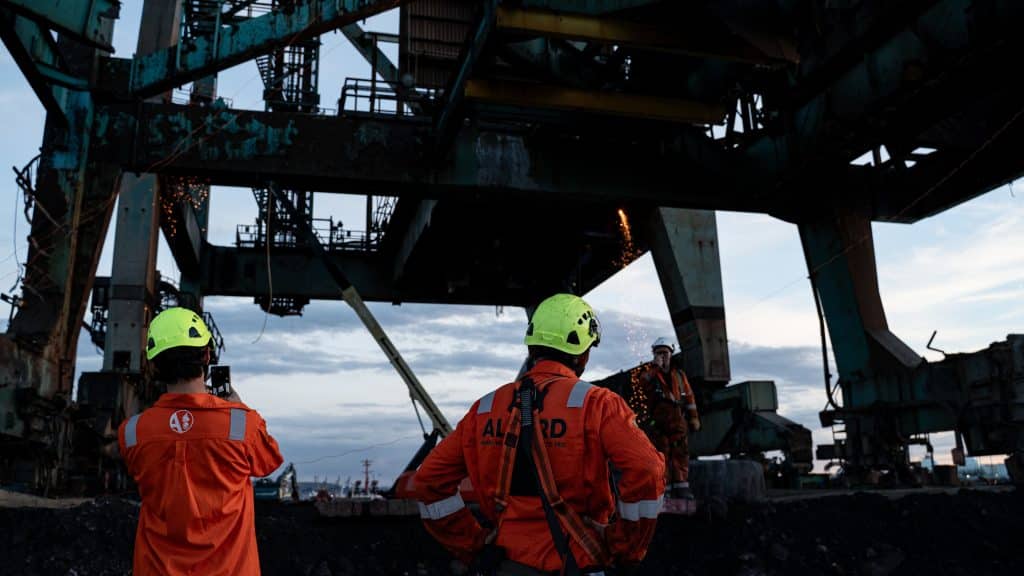
In-house demolition design
We work in partnership with our clients to thoroughly analyse their explosive demolition project, delivering safe, efficient and compliant demolition designs. This includes advanced structural engineering analysis.
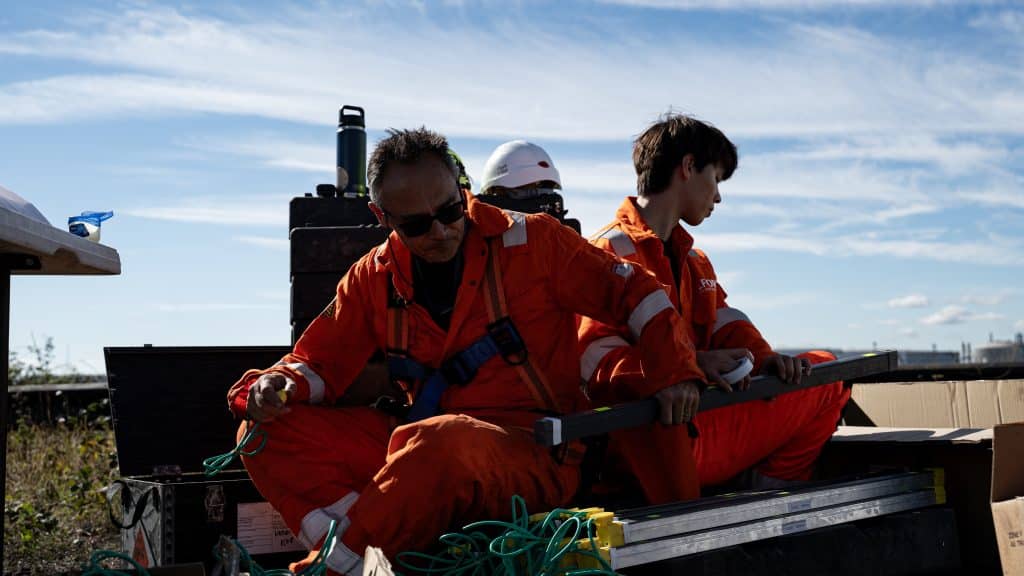
Alford products for Alford projects
Being part of Alford Technologies means we can access the full range of Alford technology and equipment, allowing us to follow the BAST (Best Available Safest Technology) principle to ensure that there are no limitations on using the best technology at all times.
From test range to project site

Testing and preparation
Alford’s test ranges at Broadmead and Emborough allow charges to be trialled, refined, and proven before deployment. Potential site conditions and structural challenges are identified and resolved during research and development, before the team steps onto the project site.

Maximising safety, minimising risk
Remotely operated vehicles place charges with operators at a safe distance throughout – from initial positioning to final detonation. The ROV fleet carries payloads of up to 75kg, and Alford can also operate remote construction tracked vehicles, including Bobcats, to prepare or clear a site without personnel entering the exclusion zone

Structural integrity maintained to the final cut
Alford’s demolition designs remove structural redundancy without pre-weakening the structure, maintaining its integrity until the controlled sequence begins. Explosive cutting charges handle the final cuts remotely, as part of the demolition itself, so no personnel need to enter or approach the structure at that stage

International Demolition Projects
In 2025, we launched a new joint venture between Alford Explosive Demolitions and the newly formed DetX.
DeTX is the result of the unification of three major players in the US demolition industry: Dykon Demolition, Precision Blasting Services, and Academy Blasting.
The joint venture between Alford and DeTX combines over nine decades of world-class expertise and experience in explosive engineering for international demolition projects.
Alford Explosive Demolition Case Studies
April – July 2016
Didcot A Power Station – Oxfordshire, England

The Didcot Power Station project required the demolition of the remaining two boiler houses following the premature collapse of boiler houses one and two in 2016, resulting in the tragic death of four workers. The demolition of the remaining (deemed) unsafe boiler houses had to be achieved from no closer than 50m, allowing for the recovery of the bodies.
This HSE-imposed 50m exclusion zone and the fact that the whole site was a crime scene (no footage/images could leave the site) resulted in a totally unique approach: remote delivery of charges, remote connection of the charges, and then remote initiation—a feat no other demolition company could consider taking on.
On 17 July, we successfully collapsed the remaining structure in a controlled manner allowing the recovery process to commence.
July – September 2018
Angelsea Power Station – Victoria, Australia

Following a partial demolition (stand-up) of the Anglesea Power Station west of Geelong in Victoria, Australia, Work Safe Victoria (the equivalent of UK HSE) placed the structure out of bounds to all personnel. Thanks to the success of the Didcot demolition, Alford Explosive Demolition was engaged to assess whether a remote demolition was possible.
A recce determined that a remote/semi-remote approach would be viable, so the Alford team took on the challenge of a remote demolition over 8,000 miles from home.
In this case, the main challenges were logistics and dealing with Australian governance and regulation.
Achieved with minimal impact on the local population of Anglesea, the demolition allowed the site remediation to continue and the development of a water-based nature reserve to proceed.
April 2020
Hazelwood Power Station Chimneys – Victoria, Australia

Hazelwood Power Station — once one of the most polluting power stations in the world, burning 17,000 tons of brown coal daily — was decommissioned after 50 years of use. Contracted by Australia’s demolition giants, Delta, for Engie, our task was to safely bring down each of the eight 134m eight chimneys with explosives.
Bringing down eight chimneys of this height in one controlled explosion had never been attempted before, so it was an exciting challenge for us. Yet, the challenge became seemingly impossible when the Covid-19 pandemic prevented us from travelling the 10,555 miles from our UK HQ for the scheduled blowdown.
However, with help from our brilliant team in Australia, we were able to train them and complete the task remotely.
With all the chimneys falling into their allocated zones and an astounding 1.6 million people watching live globally, our successful demolition job became a global event, marking a significant milestone in the industry.