IED Disposal: History, Techniques and Technology
Author: Jon Hall
Published: 13th December 2024
First published 13 December 2024 · Updated 2 November 2026
Improvised explosive device disposal (IEDD) is the branch of explosive ordnance disposal that locates, diagnoses and renders safe homemade bombs, ideally remotely and without setting them off. It exists because IEDs became the defining threat of modern conflict. Between October 2010 and September 2020, Action on Armed Violence recorded 171,732 people killed or injured by IEDs worldwide, 80% of them civilians.
This guide covers how IEDs work, how disposal evolved from the ‘long walk’ to remote robots and water disruptors, and the tools teams rely on today.
Key terms
- IED: a device made in an improvised way with explosive or other harmful materials. It may use military stores, but is normally built from non-military components.
- IEDD: the specialist EOD discipline for dealing with IEDs.
- Render safe procedure (RSP): the actions that stop an IED from functioning.
- ROV: remotely operated vehicle, the robot that lets operators work at a distance.
- Disruptor: a tool that defeats an IED by breaking up its components rather than detonating it.
- Exploitation: recovering and analysing IED components to trace the bomb-maker and their methods.
How IEDs work
IEDs vary endlessly, but most share the same building blocks, often remembered as SPICE:
- Switch: decides when the device fires, and sometimes when it arms.
- Power source: usually batteries.
- Initiator: typically a detonator, which sets off the main charge.
- Container: anything from a pressure cooker to a vehicle. An IED usually looks like its container.
- Energetic material: the main charge, military, commercial or homemade.
Some IEDs add enhancements such as fragmentation or incendiary material to increase harm. Not every device has them.
Firing switches fall into three families, which can be combined into hybrid devices:
- Victim-operated: the target sets it off, for example through pressure, a tripwire or movement.
- Command: an attacker fires it by wire or radio signal.
- Time: a timer fires it after a set delay.
Knowing the likely switch shapes every decision an operator makes, from approach route to which component to attack first.
A short history of IED disposal
Northern Ireland and the end of the ‘long walk’
The IRA’s bombing campaign of the 1970s made Northern Ireland the proving ground for modern IEDD. Early on, defeating a device usually meant an ATO walking up to it alone: the “long walk”. In 1972, Lieutenant-Colonel Peter Miller designed the Wheelbarrow, a remote-controlled robot built on an electric wheelbarrow chassis.
Wheelbarrow could carry a Pigstick, a barrelled disruptor that fires a jet of water to break up an IED’s circuit with a low risk of detonation. Together they shifted British doctrine to remote attack wherever possible. More than 400 Wheelbarrows were destroyed in action, each one taking a blast that might otherwise have killed an operator.
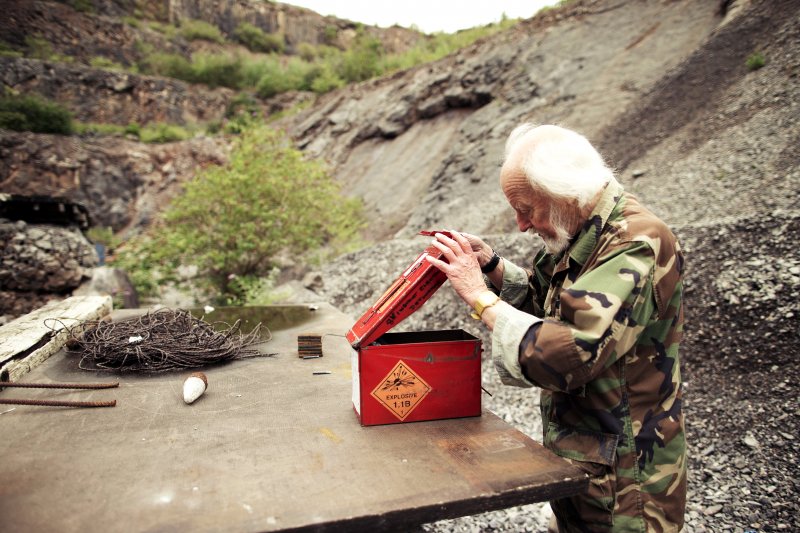
The same campaign drew Dr Sidney Alford into the field. From 1976, working with the UK’s Royal Armament Research and Development Establishment, he developed water-lined and water-filled shaped charges. That work became Alford’s explosively driven water disruptors, including MiniMod, MLVD and BootBanger.
Iraq and Afghanistan
In the post-2001 wars, IEDs became the leading killer of coalition troops. AOAV analysis found IEDs caused 48.7% of US military deaths where the cause was known, and 43% of UK deaths. Roadside bombs accounted for most of them: 73% of US IED deaths and 71% of UK ones.
The scale of the threat drove rapid change in protected vehicles, electronic countermeasures, robotics and disposal tools. BootBanger played an essential role against vehicle-borne IEDs in Iraq.
A global threat today
AOAV recorded IED use in 100 countries in the decade to 2020, and found that 58% of incidents took place in populated areas. Threats keep changing: in Ukraine, drones are now reported to be dropping anti-personnel mines.
How IED disposal works
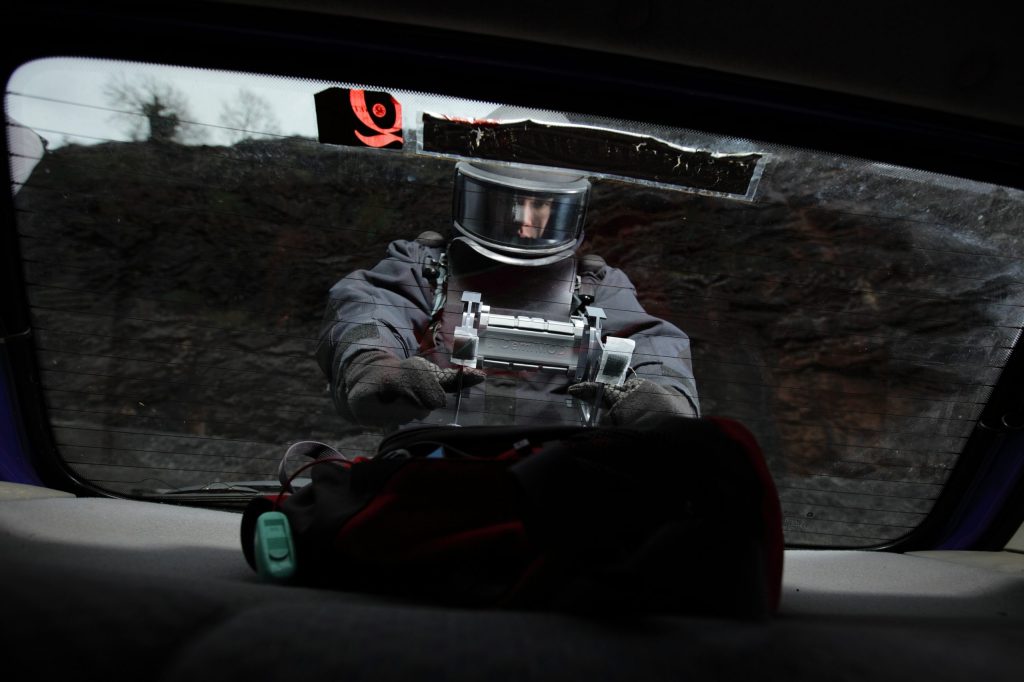
EOD operator placing an Alford DemiMod water disruptor against an IED in a car
The exact procedure depends on doctrine, threat, and setting, but most follow the same logic: gather information, work remotely, and go hands-on only as a last resort.
- Isolate. Clear and cordon the area, and control the approach routes.
- Gather information. Question witnesses and review intelligence to anticipate the device type and switch.
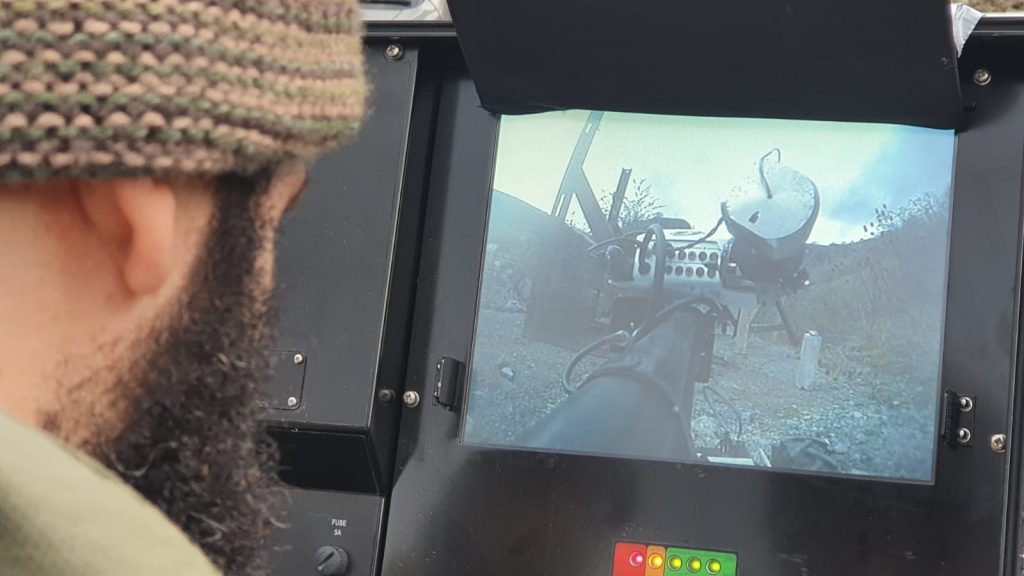
- Reconnoitre remotely. Send an ROV forward to look before anyone approaches.
- Diagnose. Use portable X-ray and other diagnostics to see inside the container.
- Render safe remotely. Disrupt the device, cut its wires or open its container at a distance.
- Exploit and dispose. Recover components for forensic analysis, then dispose of what remains.
- Manual approach, only if necessary. The long walk still exists, but it is the exception.
Tools of the trade
| Task | What it does | Examples |
|---|---|---|
| Search | Finds buried or concealed devices | Metal detectors, ground-penetrating radar, search dogs |
| Diagnostics | Shows what is inside a suspect item | Portable X-ray |
| Protection | Shields the operator and blocks radio-controlled initiation | Bomb suits, electronic countermeasures |
| Remote platforms | Carry cameras, tools and charges to the device | Bomb disposal robots (ROVs) |
| Disruption | Breaks up the IED’s components without detonation | Water disruptors such as DemiMod and BootBanger |
| Wire cutting | Severs command wires at very low NEQ | FireBreak |
| Access | Opens vehicles and containers remotely | Van Trepan |
| Exploitation | Recovers evidence to identify bomb-makers | Forensic and technical analysis |
For a deeper look at how water disruptors work and how to choose one, read IED Threat Neutralisation: How Water Disruptors Work.
What comes next
Bomb disposal robots remain teleoperated, with automation helping on specific tasks rather than replacing the operator. Light charges suit smaller robots: a loaded DemiMod weighs under 0.5 kg. Exploitation matters more than ever, because understanding the bomb-maker is how teams stay ahead of the next device.
FAQ
What does IEDD stand for?
Improvised explosive device disposal: the specialist EOD discipline for finding, diagnosing and rendering safe IEDs.
What is the ‘long walk’?
The manual approach to a suspect device by a bomb disposal operator. Remote robots and disruptors have made it a last resort.
Why disrupt an IED instead of detonating it?
Disruption avoids the full blast, limits damage to the surroundings and preserves components for exploitation.
What are the main parts of an IED?
A switch, power source, initiator, container and energetic material, often remembered as SPICE.
Build your IEDD capability
Alford supplies IEDD tools to military and government operators worldwide, and trains teams at our UK ranges. See the EOD-IEDD range, our EOD and IEDD courses, or talk to our team.
Related: How Water Disruptors Work · HME and Threat Exploitation training · “I teach dirty tricks” · Company History