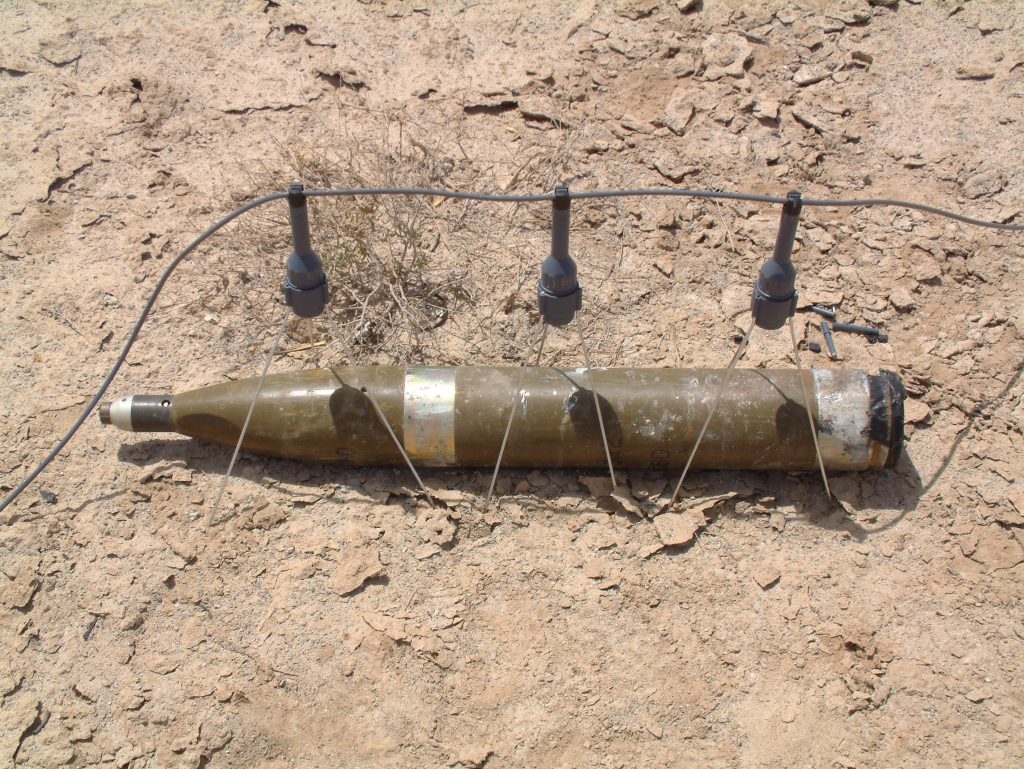

IED Threat Neutralisation: How Water Disruptors Work
Author: Jon Hall
Published: 6th March 2025
First published 6 March 2025 · Updated 2 November 2026
A water disruptor is an IED disposal tool that fires a high-velocity mass of water into a suspect device to break apart its firing circuit before it can function. Water is used because it is dense enough to penetrate light casings and tear components apart, yet as a non-metallic projectile with a high heat capacity, it is far less likely than metal to initiate the main charge.
The aim is disruption without detonation: the device is rendered safe, the surroundings are spared, and the components survive for exploitation. This guide explains the two main types of water disruptors, where each fits, their limits, and how to match the tool to the target.
Key terms
- IEDD: improvised explosive device disposal, the specialist EOD discipline for dealing with IEDs.
- Render safe procedure (RSP): the actions that interrupt an IED’s functioning so it can no longer fire.
- Disruptor: a tool that defeats an IED by physically breaking up its components, rather than detonating it.
- Tamper: material behind or around an explosive charge that directs more of its energy forward. In water disruptors, the tamper is water.
- NEQ: net explosive quantity, the mass of explosive in a charge.
- Exploitation: recovering and analysing IED components to identify the bomb-maker, tactics and supply chains.
How a water disruptor works
- Energy is released behind a mass of water, either by a propellant cartridge in a steel barrel or by a sheet explosive or detonating cord charge.
- The water is projected at high velocity as a slug, a blade-like jet or both, depending on the container geometry.
- The water enters the device and breaks it apart from the inside, separating the power source, switch, detonator and main charge faster than the circuit can function.
Two types of water disruptors
| Barrelled disruptor | Explosively driven disruptor | |
|---|---|---|
| Power Source | Propellant cartridge in a steel barrel | Sheet explosive or detonating cord |
| Projectile | Slug of water from the barrel | Shaped jet or slug of water from a plastic container |
| Scalability | Fixed by barrel and cartridge | Modular; charges join to match the target |
| Recoil and debris | Barrel recoils and must be restrained | No barrel; plastic body, low fragmentation |
| Logistics | Reusable barrel; needs cartridges | Single use; needs explosives and a licence to hold them |
| Alford examples | Draken | MiniMod, DemiMod, QMod, MajorMod, MLVD Mk2, BootBanger, Bottler |
Why use water?
- Disruption without detonation. The device is taken apart rather than set off, which is central to most render-safe procedures.
- Low fragmentation. Plastic-bodied disruptors such as QMod contain no metal components, so there is minimal projection of dangerous fragments.
- Flash and blast control. Water tamping suppresses flash and reduces overpressure. On a vehicle, that lowers the chance of igniting the fuel tank.
- Less collateral damage. Disrupting an IED in place causes far less damage to buildings, vehicles and infrastructure than detonating it.
- Evidence preserved. Components survive for exploitation, which feeds investigations and future C-IED tactics.
- Remote deployment. Most disruptors can be placed by ROV, keeping the operator at a distance.
Limitations
Water disruptors are effective, not infallible. Operators should plan for these limits:
- Opening is not defeating. Breaching or flooding a container does not guarantee the firing system is disrupted. Aim point and jet shape must target the initiation components.
- Heavy cases resist. Steel fire extinguishers, gas cylinders and barrels need blunter jets and more NEQ, or a different tool altogether.
- Stand-off and alignment matter. Performance depends on correct placement relative to the target.
- Supply and permissions. Explosively driven tools need explosives on hand. In remote or post-conflict areas, barrelled designs that can use locally sourced propellant may be more practical.
- Training. Choosing the right disruptor and aim point is a skill. Tool performance only counts if the operator can read the target.
Choosing the right disruptor

Alford BootBanger water disruptor defeating a vehicle-borne IED
Choosing the right disruptor
| Target | Suggested Alford tool | Why |
|---|---|---|
| Parcels, briefcases, power sources and switches | Draken | Barrelled; >300 m/s; propellant can come from recovered small arms ammunition |
| Boxes up to 30 litres; pressure cooker IEDs | DemiMod | Under 0.5kg loaded; cutting, penetrating jet |
| Small to medium IEDs | MiniMod, Bottler | Precise penetration; Bottler disrupts in all directions at 20 to 200 g |
| Heavy cases up to a 40-gallon drum; car doors | QMod | Blunt blade-jet for punching and crushing; 1.9 kg loaded, max 95 g NEQ |
| Medium to large IEDs | MajorMod | Multiple charges fire together for wide coverage |
| Vehicle boot or load area | BootBanger | Penetrates the floor and ejects the contents; 110mm deep, fits under a car |
| Large vehicle-borne IEDs | MLVD Mk2 | Penetrates, severs links and expels contents |
| Heavy-cased IEDs in remote areas | W-Etna | Binary liquid explosive for areas where supply is difficult |
| Command wires | FireBreak | Sub-1g NEQ wire cutter |
Where water disruptors came from
In 1976, the Royal Armament Research and Development Establishment (RARDE) arranged facilities for Dr Sidney Alford to develop his water-lined and water-filled shaped charge. One early test used a cucumber cut with a V-shaped groove, backed by sheet explosive, to cut steel with a jet of liquid. That work led directly to MiniMod, MLVD and BootBanger.
In 1987, the UK MOD recognised his ownership of water-lined and water-projecting charge technology. In 2009, Alford received a Queen’s Award for Innovation for user-filled high explosive charges to neutralise IEDs. BootBanger went on to play an essential role against vehicle-borne IEDs in Iraq.
FAQ
What is the difference between a PigStick-type disruptor and an explosively driven one?
A barrelled disruptor fires water from a steel barrel with a propellant cartridge. An explosively driven disruptor uses sheet explosive or detonating cord inside a water-filled plastic container, with no barrel.
Can a water disruptor set off the IED?
The risk is never zero. Water is chosen because it is much less likely than a metal projectile to initiate the main charge, and disruption aims to break the circuit before it can function.
Can water disruptors be deployed by robot?
Yes. Most are designed for hand or ROV placement, and some include lugs for ROV grippers.
Why not just detonate the IED in place?
Detonation causes a full blast and fragmentation damage and destroys the evidence. Disruption limits damage and preserves components for exploitation.
Build your IEDD capability
Alford designs and supplies water disruptors to military and government EOD teams worldwide, and trains operators to use them at our UK ranges. See the full EOD-IEDD range, our EOD and IEDD courses, or talk to our team.
Related: IEDD: History, Techniques and Technology · Shaped Charges · HME and Threat Exploitation training · Company History