
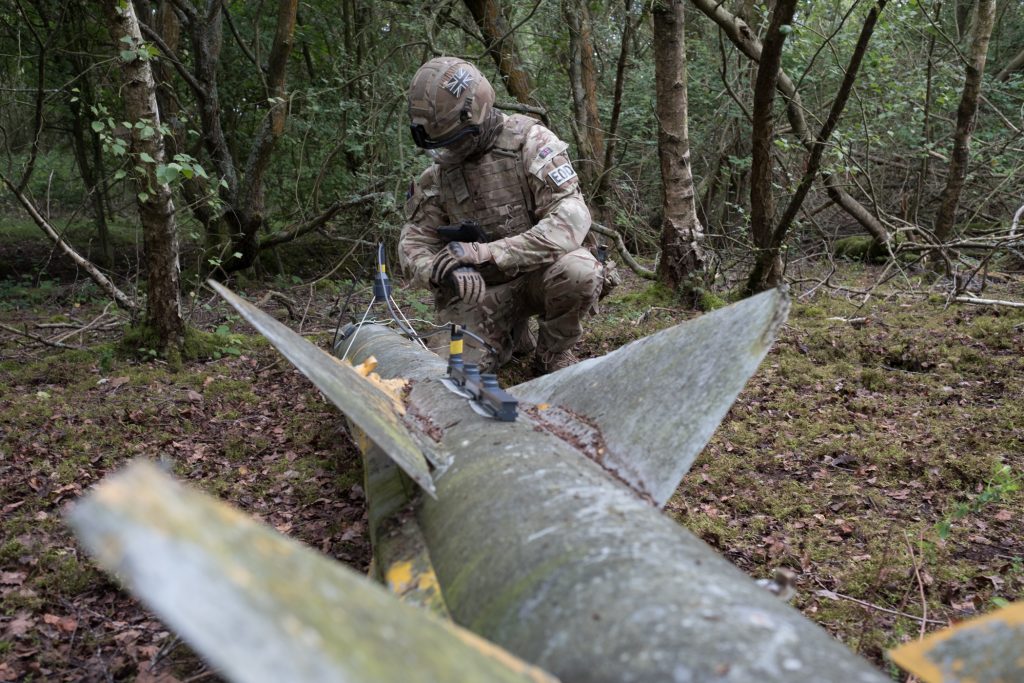
Understanding UXO: What It Is, Why It Stays Dangerous and What to Do
Author: Jon Hall
Published: 12th December 2024
First published 12 December 2024 · Updated 3 November 2026
Unexploded ordnance (UXO) is military ammunition that was fired, dropped, launched or projected but did not explode as intended. It includes artillery and mortar rounds, aircraft bombs, rockets, grenades and cluster submunitions. UXO stays dangerous long after the conflict that left it, and age does not make it safer: some items become more sensitive over time.
This guide explains what counts as UXO, why munitions fail, why old items can be more dangerous than new ones, where UXO is found, how the risk is managed, and what to do if you find something. For how contaminated land and seabed are actually cleared, see our companion guide, UXO Clearance.
Key terms
- Explosive ordnance (EO): the umbrella term for munitions that contain explosives, including mines, UXO and abandoned stocks.
- Unexploded ordnance (UXO): explosive ordnance that was primed, fuzed, armed or otherwise prepared for use, then fired, dropped, launched or projected, and should have exploded but did not.
- Abandoned explosive ordnance (AXO): munitions that were never used but were left behind or dumped by a party to a conflict.
- Explosive remnants of war (ERW): UXO and AXO together, as defined in Protocol V of the Convention on Certain Conventional Weapons. Mines are explicitly excluded from that definition.
- Landmine: a munition designed to be set off by the presence, proximity or contact of a person or vehicle. It is built to wait, whereas UXO is a munition that failed.
- Fuze: the mechanism that sets off a munition at the intended moment, on impact, after a delay or on proximity to a target.
Why munitions fail to explode
No munition works every time. The usual reasons are:
- Fuze faults. A mechanism jams, a detonator fails, or a component was damaged in storage, handling or flight.
- Landing conditions. Soft ground, water, mud or snow can cushion the impact so an impact fuze never functions. A bomb that enters soft ground at an angle can come to rest the wrong way up, so a delay mechanism does not work as designed.
- Deliberate delays that never ran. Time-delay fuzes were designed to explode minutes to days after landing. Some never did.
- Manufacturing defects in the fuze, the booster or the fill.
Failure rates vary widely by munition type. As many as 10% of the bombs dropped by Allied aircraft on Germany in the Second World War are estimated to have failed to explode. Cluster submunitions are worse: in Laos, about 80 million of the roughly 270 million dropped between 1964 and 1973 failed to explode.
Why UXO can become more dangerous with age
Time does not neutralise UXO. Several things can make an old item less predictable than a new one:
- The explosive fill changes. A 2024 study of amatol extracted from ageing explosive remnants of war found it was generally “much more sensitive to impact than previously assumed” (Novik and Christensen, Royal Society Open Science).
- Fuzes decay. Some chemical time-delay fuzes relied on acetone slowly dissolving celluloid discs that held back a firing pin. With age, the celluloid can become brittle and sensitive to vibration and shock. A decayed fuze of this type killed three bomb disposal technicians in Göttingen, Germany, in 2010.
- Metal corrodes. Rusted casings and fuzes are harder to make safe. At sea, corroding casings also release explosive compounds such as TNT into the water.
- Chemistry moves on. Older fills such as picric acid can react with metal and moisture to form picrates, which are more sensitive than the original explosive.
- The ground moves. Freeze-thaw, flooding, fires, storms, ploughing and construction can uncover buried items or move them.
Main types of UXO
EOD teams often group ordnance by how it was delivered. The group gives an operator a good idea of the likely fuze and hazard.
| Group | Examples | What to know |
|---|---|---|
| Projected | Artillery and tank rounds, mortar bombs, rockets | The most common UXO on former battlefields and firing ranges. The fuze may already be armed. |
| Dropped | Aircraft bombs, parachute mines, cluster submunitions | Bombs carry large explosive fills. Submunitions are small, numerous and often sensitive. |
| Thrown | Hand and rifle grenades | Small, but common on battlefields and training areas. |
| Placed | Landmines and booby traps | Designed to be set off by a victim, using pressure, tripwires or other triggers. Legally separate from UXO, but cleared by the same teams. |
| Sea | Naval mines, torpedoes, depth charges, dumped munitions | Corrosion, burial and seabed movement. Relevant to offshore wind, cables, pipelines and dredging. |
Where UXO is found
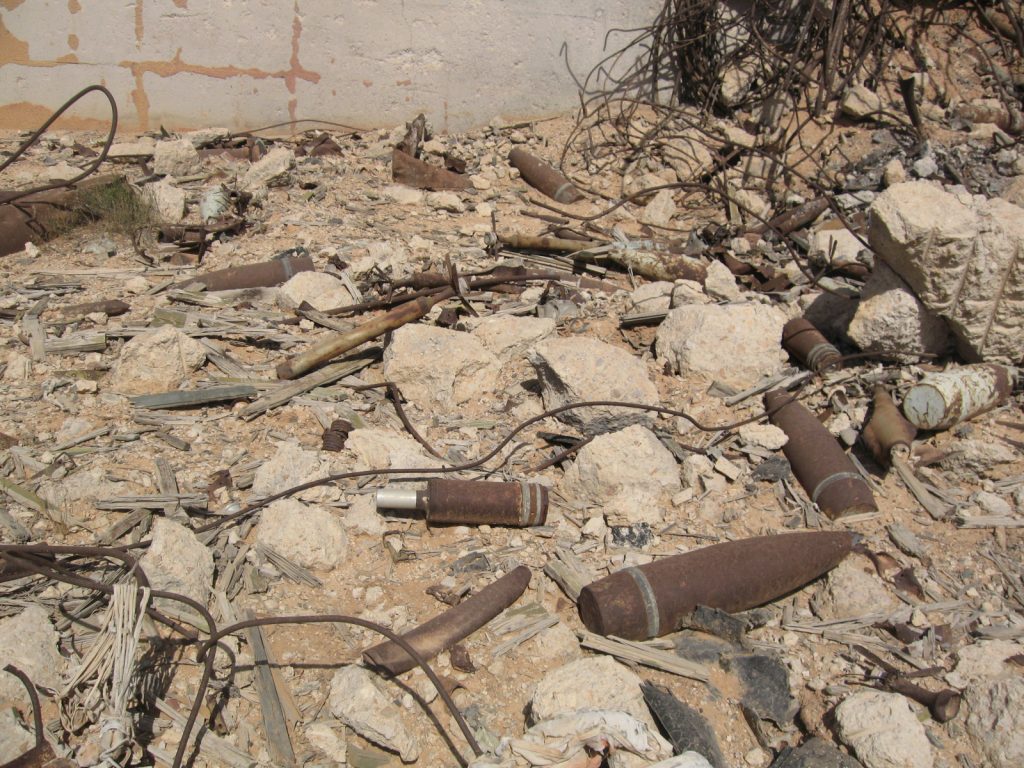
Unexploded ordnance lying on open ground in Libya
- Former and current conflict zones include Ukraine, Syria, Laos, and Libya.
- Bombed towns and cities. In the UK, German bombs from the Second World War still turn up during building work and even in gardens. In February 2024, a 500 kg SC-500 bomb found in a back garden in Keyham, Plymouth, led to the evacuation of more than 10,000 residents. Military teams towed it out to sea and detonated it there.
- Military training areas, past and present. On Dartmoor’s military ranges, the public is told not to touch military debris and to report it instead.
- The seabed. Wartime minefields and post-war dumping left large quantities offshore. Germany’s Federal Environment Agency estimates its North Sea and Baltic waters alone hold about 1.6 million tonnes of conventional munitions.
- Former munitions factories and storage sites.
How UXO risk is managed
Where UXO might be present, the aim is to understand the risk before anyone digs, drills or dredges.
On UK construction sites
The standard guidance is CIRIA C681, Unexploded ordnance (UXO): a guide for the construction industry (2009). Projects typically follow a staged approach:
- Preliminary risk assessment. A desk-based screening of historical records, such as bomb damage maps and wartime land use, to judge whether UXO is likely.
- Detailed risk assessment. Carried out once the construction method is known, because piling, boreholes and deep excavation carry different risks.
- Risk mitigation. Measures matched to the risk, from site awareness briefings to specialist supervision or survey before intrusive work.
- Emergency planning. A clear procedure for what happens if an item is found.
For marine work, such as offshore wind, cables and dredging, the equivalent guidance is CIRIA C754, Assessment and management of unexploded ordnance (UXO) risk in the marine environment (2015).
In post-conflict communities
Explosive ordnance risk education teaches people to recognise and report suspicious items. Suspected areas are marked or fenced until they can be surveyed, and land-use planning keeps homes, farming and infrastructure away from them in the meantime.
What to do if you find suspected UXO
- Don’t touch it or move it. Never take it to a police station.
- Note where it is, then move away the way you came.
- Keep other people away.
- Call the police. Phone 999 or 101. For a marine flare on the beach or below the high-water mark, call 999 and ask for the Coastguard. On a military range, follow the range’s own reporting instructions. On Dartmoor, that means the Commandant or the police on 101.
- Describe only what you can see without handling it: size, shape, markings and exact location.
On a construction site, stop work in the area and follow the site’s UXO emergency procedure.
How UXO is cleared

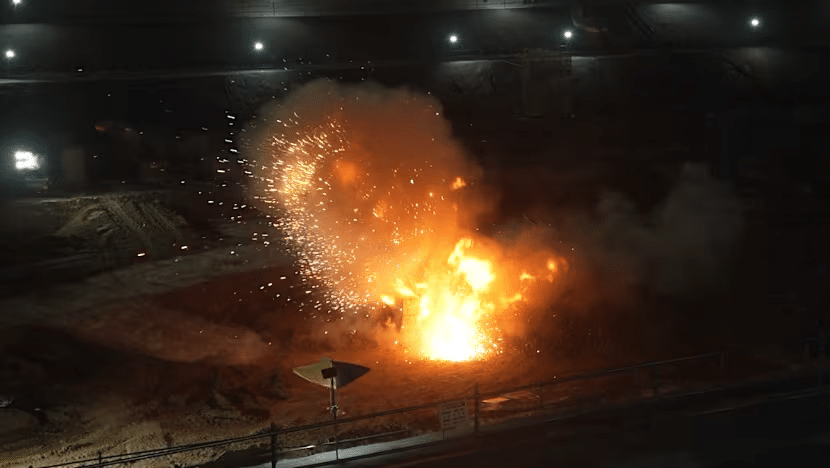
The remains of an underwater UXO following successful low-order neutralisation by a Pluton shaped charge
Clearance is specialist work: survey, detection, then disposal. Our guide to UXO Clearance covers the land release process, the detection technology and where the largest programmes are today.
The disposal method matters. High-order detonation sets off the item’s full explosive fill. Low-order deflagration uses a small shaped charge to burn out the fill instead, with far less blast, noise, and damage. Alford’s Vulcan, Pluton and Dioplex EOD charges cover both methods on land and underwater. Project REDS lets ROV operators deploy and fire them on seabed targets.
Frequently asked questions
What does UXO stand for?
Unexploded ordnance: military munitions that were used but failed to explode as intended.
Is UXO the same as explosive remnants of war?
Not quite. Explosive remnants of war (ERW) covers UXO plus abandoned explosive ordnance, meaning munitions left behind unused. Landmines are explicitly excluded from that definition.
Why didn’t it explode?
Usually a fuze fault, a soft landing in mud, water or snow, a delay mechanism that never ran, or a manufacturing defect.
Does UXO become safer with age?
No. Explosive fills can become more sensitive, fuzes decay, and casings corrode. A decades-old item can be less predictable than a new one.
Is there UXO in the UK?
Yes. Second World War bombs are still found in towns and cities, old and current training areas hold military debris, and UK waters contain wartime mines and dumped munitions. In 2024, a single bomb in Plymouth led to the evacuation of more than 10,000 people.
Do I need a UXO risk assessment before building?
In the UK, CIRIA C681 sets out how to assess and manage UXO risk on construction projects. A preliminary risk assessment is common practice, particularly on sites in areas that were heavily bombed or used by the military.
Talk to our EOD specialists
Alford designs disposal charges for military, government, commercial and humanitarian teams, and trains operators to use them at our UK ranges. Contact us or see our EOD, IEDD and Maritime EOD training.
Related: UXO Clearance · Low-Order Deflagration · Exploring Environmentally Safer UXO Disposal Methods · EOD-CMD charges
Interested in finding out how we can help you?
Related resources
Blogs

Alford Technologies Signs MoU in Romania to Expand Specialist Manufacturing and EOD Capabilities
Blogs
When the Past Resurfaces: How Alford's Vulcan Shaped Charge Safely Neutralised a WWII Bomb at Changi Airport
Blogs