Shaped Charges: How They Work, Types and Uses
Author: Jon Hall
Published: 20th January 2025
First published 20 January 2025 · Updated 2 November 2026
A shaped charge is an explosive charge shaped to focus its energy in one direction instead of spreading it evenly. Most have a hollow cavity lined with metal. On detonation, the liner collapses into a fast, narrow jet that pushes through steel, concrete or rock.
The same principle perforates oil wells, separates rocket stages and, in EOD, disposes of unexploded bombs with far less damage than detonating them. This guide explains how shaped charges work, the main types, where they came from and how they are used today.
Key terms
- Munroe effect: the focusing of explosive energy by a hollow cut into the face of a charge. In much of Europe, it is called the Neumann effect.
- Liner: the material lining the cavity. It forms the jet or projectile.
- Jet: the fast, stretching stream formed from the collapsing liner.
- Explosively formed projectile (EFP): a charge that turns a shallow dish into a compact slug rather than a jet.
- Linear shaped charge (LSC): a long charge with a V-shaped liner that produces a cutting blade instead of a point.
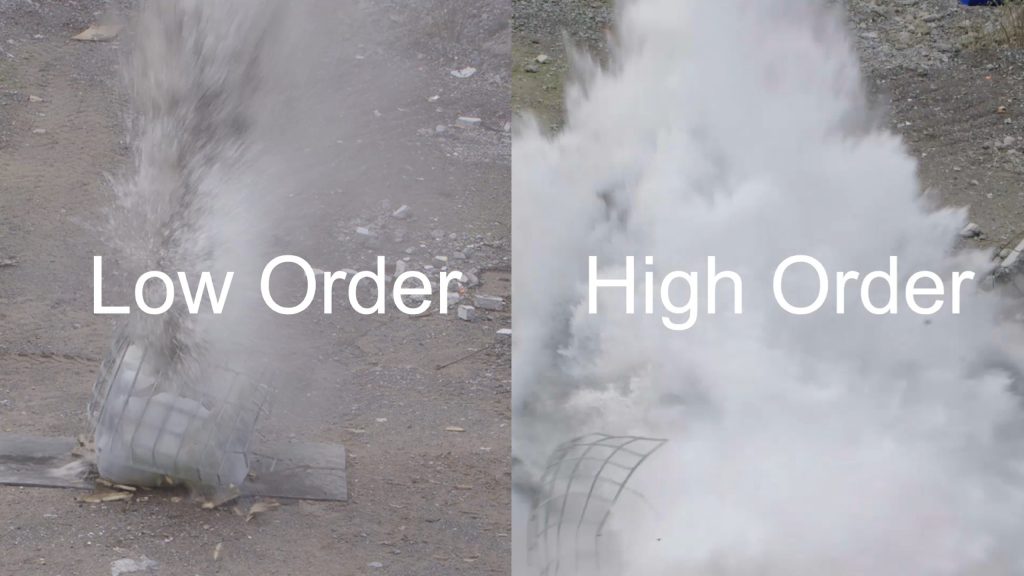
- Low-order deflagration: burning out a munition’s explosive fill without a full detonation.
- NEQ: net explosive quantity, the mass of explosive in a charge.
How a shaped charge works
- The detonation wave reaches the cavity. Energy from an explosion travels at right angles to the explosive’s surface, so a hollow concentrates it towards the cavity’s axis.
- The liner collapses. The pressure drives the liner inward until it meets itself along the centre line.
- A jet forms. Material from the inner surface of the liner is squeezed forward as a jet. The rest follows more slowly as a ‘slug’.
The jet tip travels at roughly 7 to 14 km/s. It does not melt its way through a target. The pressure is so great that steel, cement and rock flow plastically out of its path.
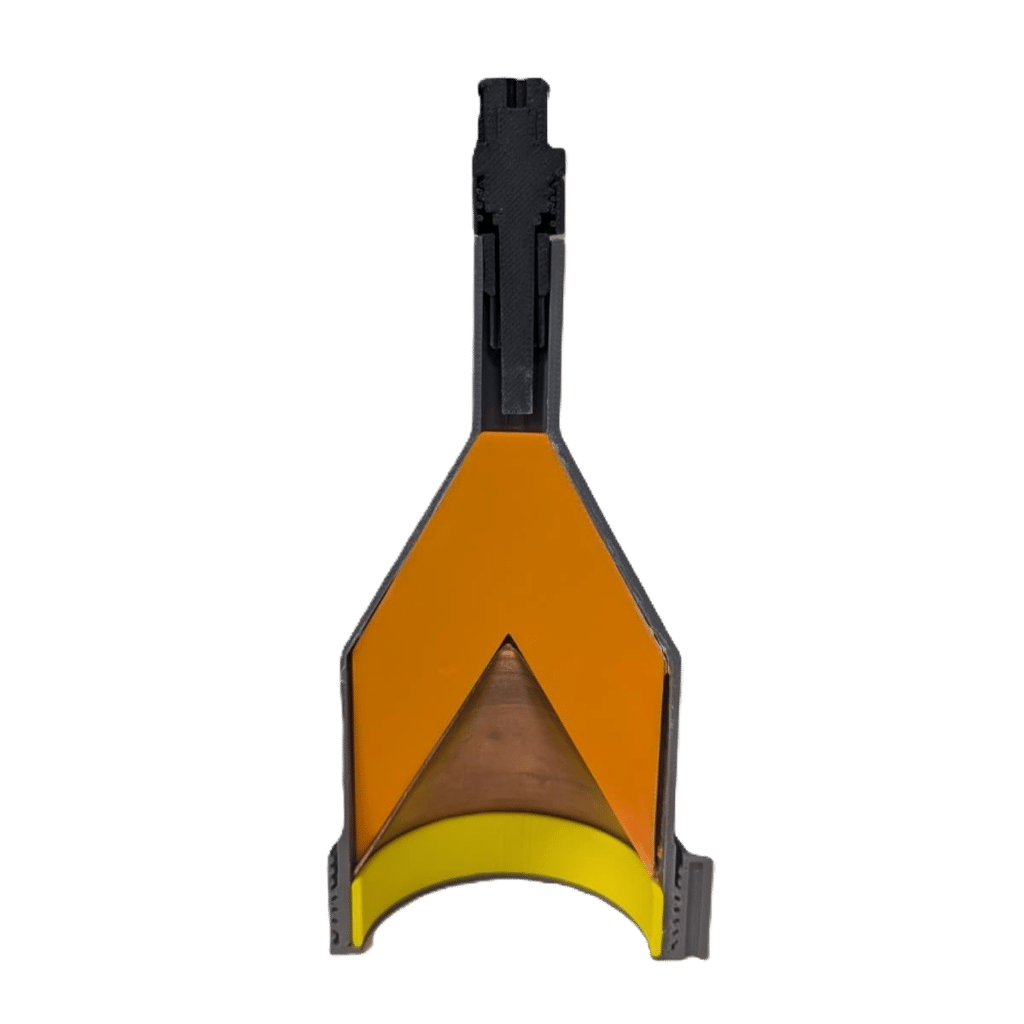
Cutaway view of the Alford Pluton shaped charge
The main types of shaped charge
| Type | Liner | What it produces | Typical uses | Alford examples |
|---|---|---|---|---|
| Conical | Jet Forming Cone, most often copper | Narrow jet; deep, small hole | Well perforation, EOD, breaching | Vulcan, Pluton, Magma |
| EFP | Shallow dish or plate | Compact slug; works at much longer range; wider, shallower hole | EOD, space science | Vulcan EFP projectiles |
| Linear | Long V-shaped liner | Knife-like cutting jet | Cutting steel in demolition, rocket stage separation, EOD | Dioplex EOD |
| Liquid lined | Water | High-velocity water jet | IED disruption with low collateral damage | Vulcan liquid projectile, water disruptors |

An EOD operator positioning Alford Vulcan and Dioplex EOD against UXO
A short history
| Year | Development |
|---|---|
| 1792 | German mining engineer Franz von Baader proposes a conical cavity in blasting charges to save powder. |
| 1883 | Max von Foerster achieves the first true hollow charge effect in Germany. |
| 1888 | Charles Munroe, at the US Naval Torpedo Station, notices that letters stamped into guncotton are cut into a steel plate. |
| 1910 | Egon Neumann shows a conical cavity lets a block of TNT punch through a steel plate it would otherwise only dent. |
| 1935 to 1938 | Henry Mohaupt develops a shaped-charge munition in Switzerland (1935); Franz Thomanek independently conceives the lined shaped charge in Germany (1938). |
| 1940 | German glider troops use unlined hollow charges against Belgium’s Fort Eben-Emael. |
| 1940s | Shaped charges enter service in anti-armour weapons including the bazooka, PIAT and Panzerfaust. |
| 1960s | Linear shaped charges separate rocket stages, as on NASA’s Atlas-Centaur. |
| 1976 | Dr Sidney Alford begins developing water-lined and water-filled shaped charges with the UK’s RARDE. |
| 1987 | Alford develops the Dioplex linear cutting charge and the Vulcan shaped charge. |
| 2004 | Vulcan wins Alford a Queen’s Award for Enterprise: Innovation. |
| 2019 | Hayabusa2’s shaped charge fires a copper projectile into asteroid Ryugu, creating a crater. |
| 2026 | A Vulcan neutralises a Second World War bomb at Singapore’s Changi Airport. |
Where shaped charges are used
Oil and gas
This is the largest use. Perforating guns lowered into a well fire rows of shaped charges through the steel casing and cement into the rock, so oil or gas can flow into the well.
Demolition and cutting
Linear shaped charges cut steel piles, columns and beams in controlled demolition. Alford’s Dioplex began this way: in 1987, Dr Alford designed user-filled cutting charges to cut the hulls of tankers wrecked in the Gulf, in air and underwater.
Explosive ordnance disposal
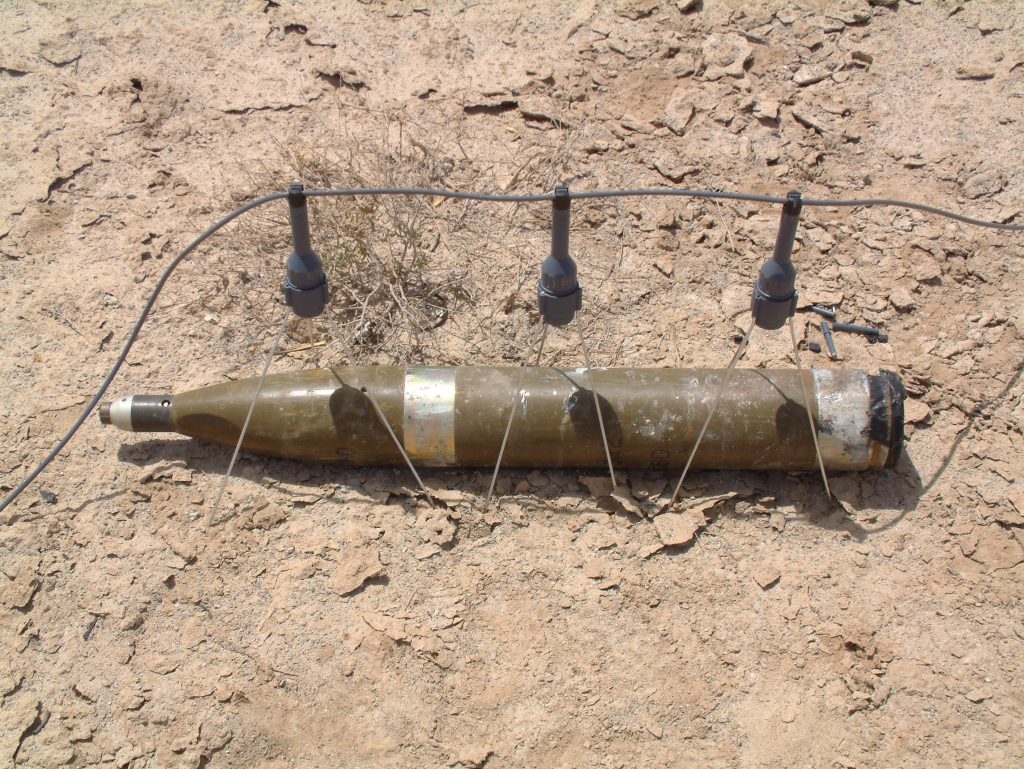
EOD teams use shaped charges to open, burn out or destroy munitions in place. The choice of liner decides the outcome. A copper jet can trigger a full detonation, which is sometimes the aim. A magnesium cone forms a jet that ignites as it forms, burning out the fill with a low chance of detonation. That is the basis of low-order deflagration, which spares nearby buildings and infrastructure. In April 2026, a Vulcan safely neutralised a Second World War bomb at Changi Airport.
Aerospace and space science
Linear shaped charges separate rocket stages and form part of flight termination systems that destroy a rocket if it goes off course. In April 2019, Japan’s Hayabusa2 dropped a shaped charge that drove a copper plate into asteroid Ryugu at about 2 km/s, digging a crater to expose rock beneath the surface.
Defence
Shaped charges have been the basis of anti-armour weapons since the Second World War, from shoulder-fired rockets to guided missiles.
The Alford approach: water and magnesium
Alford’s shaped charge work started with an unusual liner: water. In 1976, Dr Sidney Alford began developing water-lined charges, including an early test that used a carved cucumber backed with sheet explosive to cut steel. That line of work led to Alford’s explosively driven water disruptors.
Vulcan followed in 1987. Its magnesium cone gave EOD teams a simple, reliable way to deflagrate steel-cased munitions without detonating them. Today Vulcan is user-filled with 10 to 50 g of plastic explosive and offers six projectile types in copper, magnesium, aluminium and liquid. It disintegrates on firing, with no dangerous fragments. The Humanitarian Demining Vulcan brings the same principle to NGO clearance teams, and Magma scales it up for the largest munitions, including a Tallboy air bomb.
FAQ
What is a shaped charge?
An explosive charge shaped, usually with a lined hollow, to focus its energy into a jet or projectile in one direction.
What is the Munroe effect?
The focusing of explosive energy by a hollow in the face of a charge, named after Charles Munroe, who described it in 1888.
What is the difference between a JFC and an EFP?
A conical shaped charge forms a fast, stretching jet that makes a deep, narrow hole at close range. An EFP forms a compact slug that stays effective over a much longer distance but makes a wider, shallower hole.
Why use magnesium liners in EOD?
A magnesium jet ignites as it forms, so it can burn out a munition’s explosive fill with a low chance of causing a detonation.
Find the right charge for the task
Alford designs user-filled shaped and cutting charges for EOD, demolition and maritime clearance. See the EOD-CMD range or talk to our team.
Related: How Water Disruptors Work · IED Disposal: History, Techniques and Technology · Low-Order Deflagration · Company History